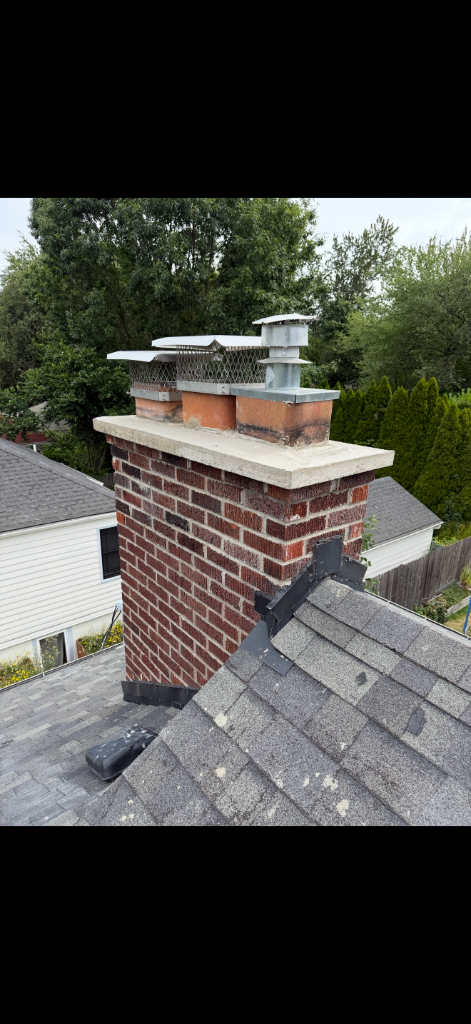
Chimney crown repair and installation by DNT Masonry

Get Your Free Estimate

Select the services you need and we'll send you a personalized quote - no obligation, no pressure.

What Do You Need?

Select all services that apply - we'll get back to you with pricing

Concrete Chimney Crown

Repair or replace the concrete cap on top of your chimney to prevent water damage and extend chimney life.

Chimney Rain Cap

Install a rain cap to protect your chimney flue from rain, debris, and animals.

Fireplace Insert Install

Professional installation of a fireplace insert to upgrade your existing fireplace for better heat and efficiency.

Liner Install

Install a new chimney liner for improved safety, efficiency, and code compliance.

Clean & Seal

Professional cleaning and waterproof sealing of your masonry surfaces to protect and restore.

Your Information

Your information is secure. We'll respond within 1 business day.

Your Request

Select one or more services to see a summary of your request.

How It Works

1Select the services you need
2Fill in your contact info
3We review & send your quote
4Schedule your service
Prefer to talk?

Call us directly for a free consultation

Call Now

Understanding Masonry Costs in 2026

Masonry pricing depends on multiple factors. Here is a comprehensive guide to help you understand what goes into a professional masonry estimate in the Pacific Northwest.

One of the most common questions we receive is "How much does masonry work cost?" The honest answer is that every project is different, and a responsible contractor will never give you a firm price without seeing the job site first. However, understanding the factors that influence cost can help you plan your budget and evaluate quotes more effectively.

Chimney Services

Chimney work is one of our most frequently requested services, and pricing varies widely depending on the scope of work. A concrete chimney crown replacement — the flat concrete cap on top of your chimney — typically costs between $500 and $1,500, depending on chimney size, accessibility, and whether any underlying brick damage needs to be addressed first. A chimney rain cap installation is a more straightforward project that usually falls in the $200 to $600 range, depending on the number of flues and the material chosen (galvanized steel, stainless steel, or copper).

For more extensive chimney work, a partial chimney rebuild — where the top several courses of brick are removed and relaid — generally ranges from $1,500 to $4,000. A full chimney rebuild from the roofline up can cost between $3,000 and $10,000 or more, depending on chimney height, complexity, and whether the flue liner needs replacement. The Chimney Safety Institute of America recommends annual chimney inspections to catch small problems before they become major structural issues — a $150 to $300 inspection can save you thousands in preventable damage.

Stone Veneer & Facades

Stone veneer installation is priced by the square foot and depends heavily on the type of stone selected. Natural stone veneer — cut from real quarried stone — typically costs between $30 and $50 per square foot installed, including substrate preparation, metal lath, scratch coat, stone application, and grouting. Manufactured (cultured) stone veneer is generally less expensive, ranging from $20 to $40 per square foot installed, because the material itself is lighter and easier to cut and fit.

For a typical garage facade or accent wall measuring 150 to 200 square feet, homeowners can expect a total project cost between $4,000 and $10,000. Full home exterior stone veneer projects on a standard two-story home can range from $20,000 to $50,000 or more. According to the Natural Stone Institute, stone veneer consistently ranks among the highest-return exterior renovations, with homeowners recouping 90 percent or more of their investment at resale in many markets.

Retaining Walls

Retaining wall costs depend on wall height, length, material, and site conditions. A basic concrete block retaining wall with standard gray CMU blocks costs approximately $25 to $45 per square face foot installed. Natural stone retaining walls — which use hand-selected boulders or cut stone — are more labor-intensive and typically cost $35 to $65 per square face foot. For a typical residential retaining wall measuring 40 linear feet by 3 feet high (120 square face feet), homeowners can expect to invest between $3,000 and $7,800 depending on material choice.

Walls exceeding four feet in height generally require engineered design and building permits in both Washington and Oregon. Engineering fees add $500 to $2,000 to the project cost, but this investment is essential — an improperly designed retaining wall can fail catastrophically, causing property damage and creating safety hazards. DNT Masonry works with licensed structural engineers on all projects that require engineered design.

Tuckpointing & Masonry Repair

Tuckpointing — the removal and replacement of deteriorated mortar joints — is one of the most cost-effective masonry maintenance tasks available. Professional tuckpointing typically costs between $5 and $15 per square foot, depending on joint depth, mortar type, and accessibility. For a chimney with moderate mortar deterioration, a typical tuckpointing project runs between $500 and $2,500. The Mason Contractors Association of America emphasizes that timely tuckpointing prevents water infiltration that can lead to far more expensive structural repairs down the road.

Fireplace Inserts & Liners

A fireplace insert installation converts an inefficient open fireplace into a high-performance heating appliance. Insert costs vary by fuel type — wood-burning inserts typically range from $2,000 to $4,500 installed, gas inserts from $2,500 to $5,500, and pellet inserts from $2,500 to $5,000. These prices include the insert unit itself, installation labor, any necessary hearth modifications, and connection to the existing flue. A new chimney liner, often required when installing an insert, adds $1,500 to $3,500 depending on liner material (aluminum, stainless steel, or cast-in-place) and chimney height.

What Affects Your Quote

Several key factors influence the final cost of any masonry project. Understanding these variables helps you make informed decisions.

Material selection: The single biggest cost variable in most masonry projects is material choice. Natural stone costs more than manufactured stone. Copper chimney caps cost more than galvanized steel. Premium face brick costs more than standard utility brick. We always present multiple material options so you can choose the combination that fits your budget and aesthetic goals.

Accessibility and site conditions: A chimney that requires scaffolding or a retaining wall site with difficult truck access will cost more than a ground-level project with easy material staging. Steep lots, limited driveway access, and projects requiring crane lifts for heavy stone all increase labor and equipment costs.

Existing conditions and demolition: Projects that require removal of old masonry before new construction can begin add demolition and disposal costs. Removing an old chimney, tearing out a failed retaining wall, or stripping damaged stone veneer requires careful work to avoid damaging surrounding structures, plus hauling and dump fees for the removed material.

Permits and engineering: Building permits are required for most structural masonry work in Washington and Oregon. Permit fees vary by jurisdiction — Clark County, WA charges based on project valuation, while City of Portland has a separate fee schedule. Retaining walls over four feet, new chimney construction, and structural modifications all typically require permits. Engineering fees apply when structural calculations are needed.

Season and scheduling: Masonry work is weather-dependent. Mortar should not be applied when temperatures are below 40 degrees Fahrenheit or when rain is expected within 24 hours of installation. In the Pacific Northwest, the optimal construction season runs from late April through October. Projects scheduled during peak season (June through September) may have longer lead times due to high demand. Scheduling in spring or fall may offer shorter wait times.

Project complexity: Intricate bond patterns, curved walls, arched openings, and multi-material designs require more skilled labor and take longer to complete. A straight running-bond brick wall is less expensive per square foot than a herringbone pattern or a wall with decorative corbeling. Similarly, a natural stone wall with irregular shapes requires more cutting and fitting time than a uniform block wall.

Return on investment: Masonry is one of the few home improvements that consistently delivers a strong return at resale. The National Association of Home Builders reports that stone veneer recoupment rates regularly exceed 90 percent, and a well-maintained masonry exterior can increase a home's appraised value by six to twelve percent compared to homes with vinyl or fiber-cement siding. Even smaller projects like chimney restoration and tuckpointing protect your investment by preventing costly water damage and structural deterioration.

At DNT Masonry, we provide detailed written estimates that break down each of these cost components so you understand exactly what you are paying for. We do not believe in vague lump-sum quotes — transparency builds trust, and trust is the foundation of every successful project. Contact us today for a free, no-obligation estimate on your masonry project. Last updated April 2026.